


Spike Jonze makes quirky movies, and his new picture, Where The Wild Things Are, is no exception. Surprised? I wasn’t. And it just so happens that I like quirky.
But, be warned: this is not a typical children’s film. No fart jokes, slapstick, or hokeyness to be found. Not to say that it’s entirely unformulaic. It has a lot of your standard plot devices, but, dammit, they work. And they’re totally appropriate.
It’s a film that, I think, will be more appreciated by older audiences because of the movie’s overall somber tone and the themes it touches on. Themes like loneliness, sadness, despair, death, love, and the delicacy of a family. It’s pretty deep. Possibly too much for little children to take in now, but they can always watch the DVD when they get older. But, if you haven’t seen it, don’t worry. It is also very whimsical and funny in parts as well.
The “wild things” themselves look hilarious with there CG faces and big hairy muppet costumes.
My personal favorite is Alexander, the goat.

The voice actors are pretty fantastic as well, you got James Gandolfini, Paul Dano, Forest Whitaker, Chris Cooper, Catherine O’Hara (funny as always), and Lauren Ambrose.
Max Records, who plays the main character, “Max”, had the arduous task of carrying the entire movie, and he pulled it off. He was/is great. It’ll be interesting to see what movies he chooses to be apart of, if any, in the future. Hopefully nothing too crummy. I’m looking in your direction, DISNEY!
Aesthetically, the film is gorgeous. Every shot, every composition is a work of art. It’s worth the price of admission on the visuals alone.
The film was shot in Australia, not just on sound stages, and it makes me very jealous that I don’t live there now. There are a plethora of locations: suburbs, the ocean, mountains, forests, and deserts.
The music also does a good job of encompassing and reflecting all the different emotions we have being felt in the story by all the characters. You got your happy, “All is love”, and your sad, “Hideaway”.
It’s very seldom that we get something atypical to come out of Hollywood, which is why it’s always a delight when surreal movies like this one come along. And with such a wide release! Do yourself a favor and experience this film if you haven’t yet. I’ve seen it twice, and I enjoyed even more on the second viewing.
Give it a chance. Don’t you deserve to not settle for mediocrity at the movies sometimes?


There's a sense of urgency in Michael Moore's voice these days. I suppose there always was but it's much more apparent in his latest movie Capitalism: A Love Story. Yes, there's plenty of muckraking and hounding, but more than that there is pleading. Pleading directed towards the audience for initiative, mobilization, and action. Sound like a hardcore song? It might as well be, the film actually opens with a punky(er) version of Louie Louie with altered lyrics which really sets the tone.
I talked a bit with Shane about where to put this one in terms of Moore's repertoire, and we both concluded that it would indeed be somewhere near the top, but not quite the pinnacle. This movie is a different beast than the rest of his movies not because the beats are different, but because of the difference in subject matter. The villain in Capitalism is a nebulous one. And in some cases it might even be tempting to call us (American consumers) the villain, as President Carter did. Moore stops shy of pointing the finger at the popcorn eating crowd, but he does show that clip of Carter admonishing the proletariat, which is jarring to say the least. The point? We're used to placation. We love being distracted (insert irony here, I know.) even when our basic rights are being clipped.
The movie itself stands up well to his others. It's not quite as sappy as the sappiest of the bunch, and it's definitely not the funniest. Though I was able to view his most outrageous stunts as being justified performances in this movie. Remember the teaser trailer?
I still feel like they are borderline absurd and impractical, but I guess that's what makes them interesting performances. I did chuckle a few times always staying careful not to laugh at the wrong times.
If this review hasn't been too descriptive, it's because, I feel I lack the tools to accurately critique this movie. In terms of movie making, everything takes a backseat to the message, which is semi nebulous itself other than capitalism=bad or Moore's attempt to soften Americas' perception of Socialism. I can say that I enjoyed it, and that it hit close to home, as I imagine it will for most who see it. And I suspect that in the long run this director will earn the title of one of the greatest propagandists of the century.

A delectable treat:
I've seen Inglorious Basterds twice now. I knew it would be better the second time. This is because Quinton Tarantino makes layered movies that are incredibly rich and satisfying. He strikes me as the kind of man who devours cinema and I think he aims to present something so tasty that it requires a second helping.
As I sat in the theater (both times) I was very aware of the audience behind me and was paying attention to their participation. This movie is as much about what's on screen as it is who's watching it in a Michael Haneke kind of way. We've all seen representations of people sitting in theaters on film. There is also the iconic representation of wide eyed faces lit with flickering light and the warmth of the cinema. This is how this movie made me feel. I could have been Michael Pitt in the Dreamers, Austin O'brien in Last Action Hero, or Audrey Tautou in Amelie. All these fine actors played characters whose eyes devoured the movies they watched. This is an analogy that I'm sure is not lost on the director. There were several scenes in the film which revolved around our main antagonist devouring sumptuous foods (creme and milk). The shots in this movie seem to savor the performances of the actors. Slow push-ins emphatically draw tension even when the scene is happening outside the frame. The scene where Landa devours his strudel, just before we expect him to lay into Shosanna, is a perfect example of this. During the conversation immediately preceding that scene, Zoller introduces Landa to Shosanna in German. The conversation takes place outside the frame and all we see is Shosann's face. She, of course does not speak German, so she is silent but we understand her predicament by the expression on her face. I can attest, one viewing doesn't cut it. It cinema made for cinema lovers.
Christopher Waltz performance as Col. Hans Landa stole the show.
I was expecting a completely different crowd after seeing the trailer, which can be very misleading. I was expecting a bunch of raucous Nazi haters booing and hissing with the ferocity of Hitler himself. It wasn't like that at all. The crowd was calm and actually cringed at the brutality in the film. Which surprised me. I thought for sure that Tarintino's goal was to coax that blood-lust out of his audience only to reveal it as an obvious parallel to the Nazi audience watching the propagandistic hero film. I was expecting my audience to be cheering for brutality against the "evil" Nazis while the Nazi audience cheered for the downfall of American soldiers in their little movie. This would have been the perfect parallel for me to elaborate on for paragraphs, but alas, it didn't happen. The crowd was quit civil. Which makes me wonder if Tarintino, as well as myself, underestimated the movie's audience. Or maybe I had really docile crowds. Either way, this revelation didn't really detract from the movie. It only added another layer to the cake.
If the trailer was truthful about anything it was Tarintino's use of hyperbolic characters that were so "colorful" that they couldn't be seen as anything other than the most broadly painted stereotypes. Aldo Raine's Tennessee accent, the frenchman's dairy farm, Hitler's villianesque cape are all supreme examples of this. But that's what made this movie so lush. It's not a history lesson, it's a re-imagining of the past painted in colors so vivid that it couldn't possibly be boring. 
We already know that the director is more than capable of making an awesome revenge flick or two, but is this what we would normally consider a revenge movie? It seems to me that this is the kind of propagandistic retelling of history we would be used to from the opposing side. But why? I guess I'm still a little confused about this one. Is it to blur the distinction between them and us? Evil and good? Was it that deep? I suspect Tarantino didn't want any one to cut that deep into his elaborately structured supremely sweet cake (obviousness aside). I suspect, and I'm guessing he'd say the same, he just wanted to make a kick ass movie. Which it is, and damned tasty too.
P.S. I hope that Shane will chime in in the comments section.

POTENTIAL SPOLIERS!
Funny People, in these reviewers’ eyes, is not a dramedy. Like all the previous Judd Apatow movies, it’s mostly jokes. It’s pure comedy. It’s really only mature in its subject matter: a lonely, bitter, unhappy, desperate man (celebrity) trying to cope with his impending death. This is the first plot, the third act goes into a new direction having to do with Sandler’s character trying to win back the love of his life after becoming well again. Unfortunately for him, though, she’s married and has two kids. The only real dramatic moments in the film, I guess, involve Adam Sandler shouting at Seth Rogen a couple of times. I’d expected more.
But the movie does deliver when it comes to jokes, and there are plenty of jokes. Crude, tasteless jokes. Vulgar jokes. The kind a guy like me can really dig. All of the main characters in the film are comedians. Some are already established in the comedy world (Adam Sandler), while others are potential up and comers (Seth Rogen and Jonah Hill).
If you’re looking for a little insight into the world of stand up comedy this would be the picture for you to see. Judd Apatow, the director, used to be a comedian himself who also wrote jokes for comedians Roseanne and Tom Arnold. The comedy in the film is typical of a Judd Apatow movie. There’s lots cursing and talk about male and female genitalia, masturbation, relationships, geeks and nerds, and a whole lot of movie and pop culture references. But some of the best gags for me came from the celebrity cameos, of which there are many. My favorite one would have to be James Taylor’s appearance with Seth Rogen’s character where he ends up using a lot of “blue” language, if you know what I mean. And Eric Bana, for the short time he’s actually in the movie, is hilarious as well playing a moody Australian traveling salesman grounded in eastern philosophy.
What’s atypical about this Apatow picture, and what I found to be the most enjoyable aspect, are the characters themselves. I’m used to seeing Seth Rogen playing lazy, sarcastic stoners, incompetent deviant police officers, or mentally unstable, date raping mall security guards, but in this movie he actually plays a very amiable, hard working, compassionate guy whose doesn’t smoke pot once! Adam Sandler on the other hand is the complete opposite of Rogen’s character: he’s a very mean, angry, and empty person. But, of course, he does have his redeeming qualities, which we see towards the end of the film. Sandler hasn’t played anyone this grumpy since Happy Gilmore.
Funny People is a decent film. Not my favorite comedy from this year (that cherry goes to Land of the Lost!), and not even my favorite Apatow movie, but it’s not terrible either. I certainly wasn’t bored. This is probably Adam Sandler’s best role since Punch Drunk Love, and Seth Rogen has shown us he has the acting chops to take on a role different from what we’re used to seeing him in. So it’s not all bad. My only disappointment was that Funny People wasn’t as big a leap forward in maturity for it’s director/writer, Judd Apatow, as I’d thought it would be.

Before the fifteen-minute mark in Bruno, Sacha Baron Cohen treats us to a slapstick sex montage evolving the movie’s main protagonist and his gay lover. You’d be shocked if it wasn't so ridiculous and cartoon-like in nature. Bruno spins and contorts his lover around like something out of Cirque du Soleil. Various gags evolving phallic gadgetry ensue: Neither character seems to particularly enjoy the carnal activities. No, the filmmaker's goal was not to create a fair portrayal of homosexual intimacy, but rather a cruel joke at the expense of the matter. This kind of makes you wonder, in 2009, how does a movie billed as a summer blockbuster comedy contain such unadulterated trash?
Perhaps western  popular culture has hit a new low. Undoubtedly jaded by the Bush Years, Filmmakers like Sacha Baron Cohen and director Larry Charles prey on what they consider the destroyers of modern civilization. The vain, the stupid, the predominantly American. You know, the same people they burned down in their 2007 smash hit Borat.
The formula from their last quarter-of-a-billion-dollar outing is employed here with Bruno. I’ll let you in on Cohen’s secret for box office success. Create a despicably offensive stereotype of a character based on a kind of person that you despise (in Cohen’s case, a anti-Semitic Eastern European in Borat, and narcissistic Aryan male model in Bruno). Use said character, which within it’s own right, is offensive, to prod at real life people who you yourself, find offensive (in Cohen’s case, dimwitted Americans from California and Alabama, with the occasional Middle eastern Muslim thrown into the mix).
The people behind Bruno’s 10-million plus marketing campaign would have you believe that this movie is nothing more than a naughty shuck-fest aimed to take your mind off the ugly realities outside of the Cineplex. If only. Bruno is nothing more than a collection of ugly realities, lead by a disgusting ringleader who dances around the flames with a crooked smile.
In Bruno, Cohen cements himself as the clown prince of leftist elite prejudice, and if you find yourself laughing at his brand of ugly, cynical humor you’re either in his company or at the butt of the sick and twisted joke that is his mainstream Hollywood success.

Ice Age: Dawn of the Dinosaurs is the epitome of celluloid crap. A movie that is so safe, so creatively impotent and inherently lame that it is certain to be a product of stockholder movie-making.
We pick up where we were last left off with this dreadful cast of prehistoric bores. The same focus-tested and downright unpleasant characters from the last two films are back, and are as irritating and depressing as ever.
Ray Romano manages to be even more of a downer than his sitcom counterpart as the “hero” in this animated family feature. Queen Latifah resumes her role as mastodon Raymond’s lover, the only female character with a speaking role. Unfortunately she never has anything interesting to say but an occasional sassy quip, rendering the character more of a 21st Century mammy than leading lady. Dennis Leary is back as the crestfallen sabertooth who is the movie’s security force. Anytime the other pathetic characters are threatened by temperamental toons, Leary’s cat sweeps in to save the day. This is the full extent of the character. Sulk. Rescue. Sulk. Rescue. Wash, rinse, repeat.
The list of useless, disposable characters goes on. How could I forget the creepy pedo-sloth voiced by career movie pest John Leguizamo. Don’t forget the two weasel brothers, whose lines are always bookended by exclamations of “Dude!”, “Awesome!”, and “Totally!” You know, stuff that cartoon characters said 17 years ago. Ninja Turtles don’t even talk like this anymore.
And as if this series didn’t have enough characters, they added another furry tuft of dread to the stuffed animal heap. I can see the CEO of Fox sitting in on the story meetings: “Could we work in Johnny Depp’s character from the pirate pictures?” They couldn’t afford Jack Sparrow so they settled on Shaun of the Dead. Simon Pegg lends his voice to the casts third weasel character: a mad frontiersman who leads the other characters through the movies mundane “save our friend that we really don’t even like that much” plot. This character reaches new heights of being annoyingly in your face: anytime Pegg’s character says anything that’s supposed to be funny or important, the camera crash zooms in on his ugly one-eyed mug.
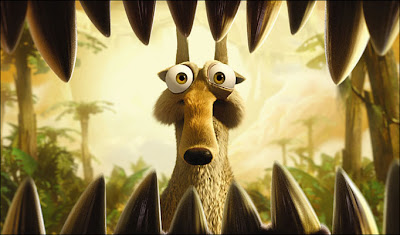
I don’t mention the names of the characters in this movie because I don’t remember them. Characters from Pixar movies (and occasionally Dreamworks) stick with you. You remember their charm, quirks and names. The only memorable character in the Ice Age universe is Scrat, a saber-toothed squirrel whose life ambition revolves around catching a stray acorn.
As in the past two movies, his dialogue free screen time is limited to vignettes here and there that proceed when the writers hit a brick wall. Scrat is relatable and actually, ahem…funny. A character that channels the sadness of Chaplin and the slapstick grace of Buster Keaton.
Scrat’s misadventures clearly display that the talents behind Ice Age: Dawn of the Dinosaurs are capable of crafting an endearing and thoroughly enjoyable movie experience, if only the stockholders allowed them.


Warning: Potential spoilers!
One might suspect when entering the cinema that they're about to witness the rise and fall of the infamous bank robber, sociopath, and all around scumball John Dillinger (played by Johnny Depp). But this plot presumption would be wrong. We see no rise, only the fall. The film begins in September of 1934, Dillinger's first prison break, and follows him until his demise eleven months later. Everything starts going wrong for him, basically, from the beginning of the movie.
John Dillinger likes fast cars, movies, woman, and money. And he's not the type of fellow who is "thinkin' bout tomorrow". That's about all we get about the man. There's no real insight into his past and why he is the way he is, and why he has this obsession with living on the edge. In this universe he's somewhat of an enigma. Some, after seeing the film, might view this lack of character development as grounds for some deserved negative criticism, but I didn't care. He more than makes up for these ambiguities with his humor, charm, and cockiness. Perhaps the real Dillinger was a mystery as well.
Those who are also anticipating a non stop thrill ride of murder, sex, brutal gangster violence, and bank robberies might also be disappointed. Although the highlight for the film, for me, does involve a car chase and a shoot out between cops and robbers, the action is very sparse. Mostly a lot of chit chat between thugs in jail cells, restaurants, and hideouts. The character of Dillinger spends nearly half the film falling for a dame he meets in a club in Chicago. Their ultimate goal is to go away together after Johnny makes his final big score. You already know what's gonna happen, don't ya? The film looks great though. Obviously a lot of work went into the costumes and sets to make it look like 1930's midwestern America, rural and metropolitan. I read somewhere that they did a lot of the filming for this movie where the real events actually took place. That's always great for authenticity.
Now comes the part where I tell you if I liked the movie or not: yes. I did. Overall, a solid picture. It was entertaining. The 2 hours and 20 minutes flew by without me looking at my watch. Is it an amazing film? Of course not. Very rarely do I ever see, or expect to see, and amazing work of cinema that totally blows me away. I suppose, now, I'm a little cynical when it comes to movies. Especially Hollywood movies.
This picture gives you the basic hollywood gangster movie package: a little action, some drama, decent performances, and a love story. Nothing new under the sun. And that's just fine by me. Also: since I'm reviewing a biopic about Dillinger I might as well mention another biopic I saw last week about another 2oth century hero to some, and fiend to others: I'm talking about last years Che. Part 1 and 2. If you can handle a four hour movie I'd very much recommend it. I think I actually liked it more than Public Enemies. It was more of an intriguing film, for me, because of the fact I knew close to nothing about it, or its main character, Che Guevara. So there was an element of genuine surprise. Plus, his story is more compelling than the story of Dillinger to me. Benicio Del Toro gives a fine performance, which is important considering the film focuses entirely upon him, plus the visuals and the locations where they shot it were quite beautiful. Check it out if you get the chance.

"This above all: to thine own self be true,....." - Polonius (from the play, Hamlet)
The above quote states what I believe to be the overall moral message of Sam Raimi's, "Drag Me To Hell". Here we have a character, a young woman, who has ambivalent feelings towards herself and where she comes from. Christine's a good person, but feels she has to appease other people, her boss, boyfriend, etc, rather than herself in order to be happy and get ahead in life. This behavior is, ultimately, her downfall. Christine feels the pressure one day and goes against her moral barometer, she denies a sick woman an extension on her mortgage, she "shames" the old lady, and it is this reason she must now suffer a curse. A very deadly curse. In three days time, a demon will come to take her soul and body to hell where she'll suffer for an eternity. The main focus of the film is, of course, her trying to rid herself of this curse by any means necessary. Will she succeed? Go and see it to find out!
I am in no way an avid fan of the horror genre like some, I think most of them suck, but I did enjoy this one. You might even say that I enjoyed it more than the directors previous horror films, "Evil Dead", "Evil Dead 2", and "Army of Darkness". One of the successes of this movie is that I actually sympathized and cared about the main character, Christine. And for a film to have any real impact it's important to feel for a character in crisis. Plus, like all of the Sam Raimi movies I've seen over the years, it was very entertaining. I can't deny this. It's loud, very crude, cringe worthy in some parts, obnoxious, and there are a lot of boo scares. You know? Boo scares? They're very popular nowadays.
However, in a horror film, personally, for me, boo scares aren't enough to make a film truly frightening. Something more is required.
This film, basically, just screams in your face in order to try and scare you, but I was never spooked. I personally prefer, and this is rare to find in most modern horror cinema, something a little more creepy, something with a little more subtly that builds up to a truly horrifying experience. This is one flaw I've found in all the Raimi horror movies. There's a lot of shock, but no fear.
Maybe I'm asking for too much though. Sam Raimi is the man behind the hugely successful "Spiderman" franchise, and he's been in the game a long time, so it's safe to say he's got a lot of pull in what projects he chooses to participate in and how they're executed. Apparently Raimi had a different vision of how this movie should be and went forward with that vision. He didn't want the same things I did. I respect that. He's being true to himself as a storyteller and filmmaker, I guess. Polonius would be proud.
Addicted to Media 2008,2009,2010
